- Kenji Morgan
- Publish Smart
- <25
- 0
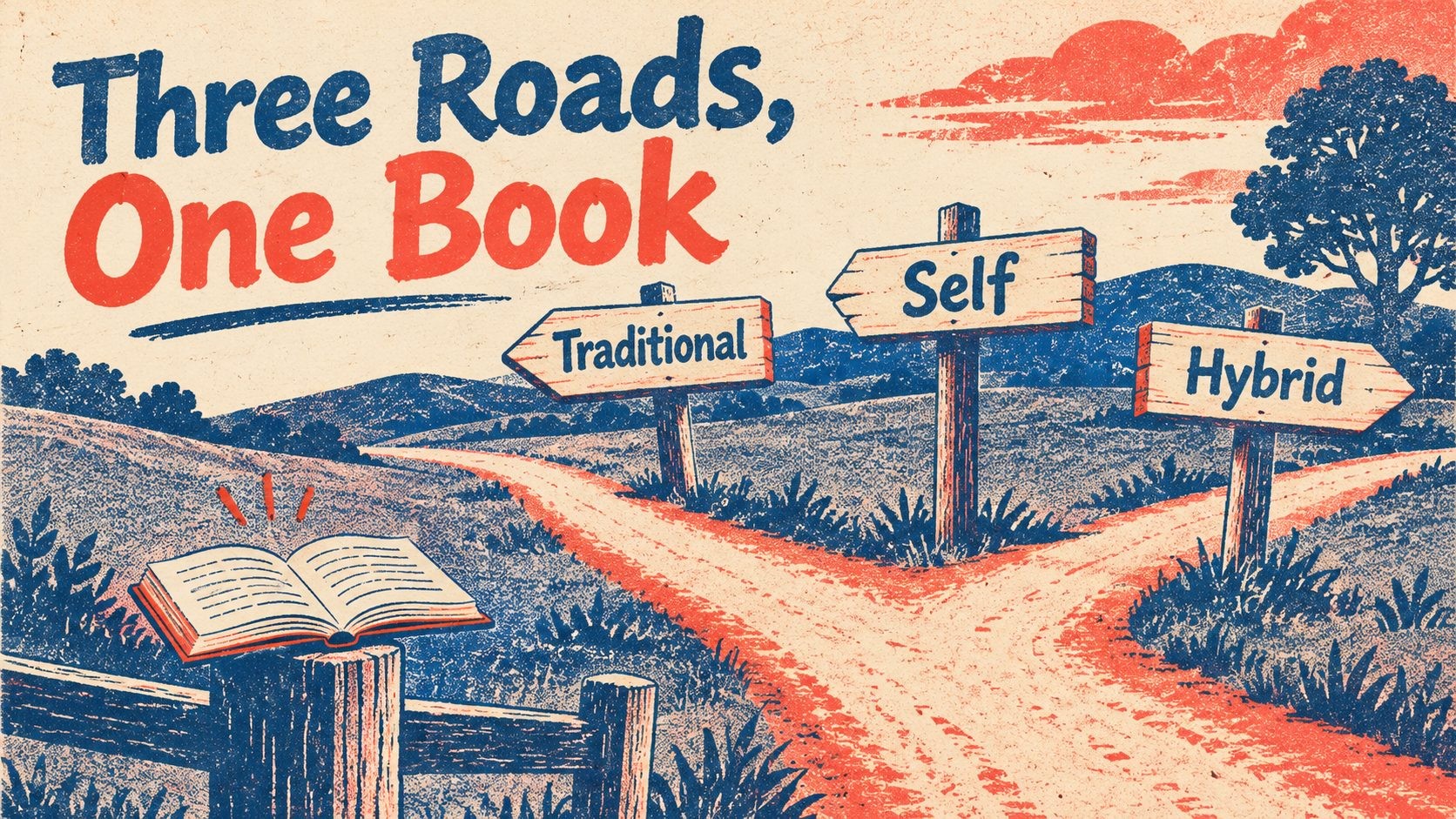
Picture a finished manuscript on your desk and three signposts in front of you. One says traditional publishing. One says self-publishing. A third, a little harder to read, says hybrid. Three friends have given you three different directions, and each one sounded completely sure.
Here is the short version of the traditional vs self publishing question. With traditional publishing, a publisher pays you and controls more of the book. With self-publishing, you pay for the work and control everything. With hybrid publishing, you share the work and the cost with a company that provides professional services under a contract.
None of these roads is right for every author. The right one depends on your goals, your budget, and how much patience you have.
In this guide, you will get a side-by-side comparison, real money examples, a way to vet hybrid publishers, and a four-question decision path. By the end, you will know which road fits your book, and why.
Traditional vs self vs hybrid publishing at a glance
Before the details, here is the whole picture on one screen. Figures are typical ranges, so treat them as a starting point and read any contract closely.
| Traditional | Self-publishing | Hybrid | |
|---|---|---|---|
| Who pays upfront | The publisher | You | You, or you and the company |
| Typical royalty | Often 5 to 15 percent, plus an advance | Often 35 to 70 percent, depending on format and platform | Varies widely, often higher than traditional |
| Control | Publisher has the final say on title, cover and price | You decide everything | Shared, as set by the contract |
| Speed | Often 1 to 2 years or more after signing | Weeks to a few months | Usually faster than traditional |
| Bookstore reach | Strongest | Hardest | Depends on the company |
| Rights | Often held by the publisher for years | You keep them | Check the contract |
| Best fit | Authors who want an advance and prestige | Authors who want control and speed | Authors who want help and can pay for it |
No road wins every row, which is why the rest of this post walks through each one.
What is traditional publishing?
Traditional publishing is the route most people picture first. A publishing house buys the right to publish your book, pays you, and takes on the production and distribution work.
The path usually looks like this. You finish the manuscript, find a literary agent, and the agent pitches your book to publishers. If a publisher says yes, you sign a contract, and the publisher handles editing, design, printing, and getting the book to stores. Most major publishers only accept manuscripts through agents, so landing one is often the first big hurdle. Expect to send a polished query letter and sample pages, and to hear no far more often than yes. Many successful authors collected dozens of rejections before an offer, so persistence is part of the job.
On the money side, you pay nothing upfront. The publisher usually pays an advance against future royalties, and you earn royalties once your sales cover that advance.
The upsides:
- No production costs for you
- A professional team for editing, design, and sales
- Strong access to bookstores and libraries
The downsides:
- It is slow, often a year or two after signing, plus the time it takes to find an agent and a deal
- Royalty rates per copy are lower
- You have less say over the title, cover, and price
Publishers also plan their lists well ahead. Even after you sign, your book may wait a season or two for a slot on the calendar, and the publisher decides how much marketing support it gets. Many first-time authors are surprised by how much promotion they still do themselves.
Be honest with yourself about the odds, too. Most manuscripts do not get picked up, and agents earn a commission on your deal, commonly around 15 percent, so check the current norm before you sign anything.
This road fits authors who value prestige and bookstore presence and are comfortable giving up some control.
What is self-publishing?
Self-publishing means you act as the publisher. You own the rights, you make the decisions, and you either do each job yourself or hire people to do it.
On the money side, you pay for editing, cover design, formatting, and marketing, and you keep a much larger share of every sale. Many authors use print on demand, so they are not buying a pile of books upfront. You also choose where to sell. Most authors start with Amazon, then add other stores or a print distributor later, so you can adjust your plan as you learn what works.
The upsides:
- Full control over your title, cover, price, and release date
- Speed, since a book can be live in a couple of months once it is ready
- A higher royalty share on every copy
The downsides:
- Upfront costs for editing, design, and marketing
- You manage every job, or you hire and manage the people who do
- Getting into physical bookstores takes extra effort
Here is the part many guides skip. The quality of a self-published book depends on the team you build. Editing and cover design are what make a book look professional, so those are the two places not to cut corners.
Self-publishing also asks for a different kind of energy. You will make hundreds of small decisions, from a font to a launch date, and nobody will approve them for you. Some authors love that freedom, and others find it tiring, so be honest about which one you are.
If you want the step-by-step version, our guide on how to self-publish a book walks through every stage from editing to launch.
What is hybrid publishing?
Hybrid publishing sits between the other two roads. The author pays for production or shares the cost, and a company provides services such as editing, design, distribution, and sometimes marketing under a written agreement.
Compared with self-publishing, you get more support and one point of contact. Compared with traditional publishing, you usually keep more control and earn a higher royalty. The tradeoff is cost. You are paying real money, so what you get in return matters.
Business models differ, too. Some companies charge a flat package fee and then pay you most of the sales income. Others split the cost with you and keep a share of the revenue. Neither is automatically better, but you should be able to explain the model back in one sentence after reading the contract. If you cannot, ask more questions.
Here is the catch. The word "hybrid" is used loosely. Some companies run a fair, transparent model, and others charge large upfront fees and deliver very little. The label tells you nothing on its own, so the contract and the track record do. For a deeper look at how to spot trouble, see how to spot publishing scams. Resources like Writer Beware also track fee-charging companies and common warning signs.
A 7-point vetting checklist for any hybrid publisher:
- A written scope of work and a clear price list
- A plain statement of who owns the rights and the files
- The royalty rate in writing, including what it is based on
- Real distribution, not just a listing on an online store
- Honest sales records and past results you can verify
- References from authors you can actually reach
- No pressure to sign fast or buy extra packages
If a company fails two or more of these points, walk away or ask for changes in writing. A good partner will welcome the questions, because they have answered them before.
The Independent Book Publishers Association has published a set of standards for this model, so read the Independent Book Publishers Association's hybrid publisher criteria and compare any company against it.
If you want a full-service route, KD Prime Publishers book publishing is one option to compare against the checklist above. Whoever you consider, ask for everything in writing and take your time.
Royalties and money compared
Money is where the three roads feel most different, so here are the basics.
In traditional publishing, you usually get an advance, which is a payment against future royalties. You keep the advance even if the book does not earn it back, and you only receive royalties after sales cover it. Royalty rates are often cited in the 5 to 15 percent range, and your agent takes a commission.
In self-publishing, you earn a share of each sale, often 35 to 70 percent for ebooks and a lower share for print once printing costs come out. You get no advance, and you pay your own bills first.
In hybrid publishing, the rate and the fees vary by company, so the contract is everything. Some hybrid contracts pay a high royalty on net sales, which sounds generous until you check how net is calculated, so ask for a sample royalty statement.
A worked example. These numbers are illustrative, not predictions. Say you sell 5,000 copies of a $20 paperback.
- Traditional: A 10 percent royalty is about $2 a copy, or $10,000 before your agent's commission.
- Self-publishing: Say you list at $16.99 and keep about $6 a copy after printing and retailer costs (use KDP's royalty calculator for your real number). That is about $30,000, minus roughly $4,600 in editing, design, and marketing, which leaves about $25,400.
- Hybrid: Say you pay a $4,000 package and earn about $5 a copy. That is $25,000, minus the $4,000 fee, which leaves about $21,000.
Now the reality check. Selling 5,000 copies is a big assumption. Self-published books often sell far fewer without marketing, while a traditional publisher may put a book in more stores. Earning more per copy does not mean earning more overall.
A simple way to compare is to ask three questions about each road: what do I pay, what do I earn per copy, and how many copies can I realistically sell? Write the three numbers side by side. It takes ten minutes and often changes which road looks best.
One more tip: royalty percentages apply to different bases, such as the list price or the net amount the publisher receives. Always ask which one the contract uses.
Control, speed, and bookstore reach compared
Control. In traditional publishing, the publisher usually has the final say on the title, cover, price, and release date. In self-publishing, every one of those decisions is yours. In hybrid publishing, it depends on what you negotiate.
Speed. Self-publishing is the fastest, and a book can be live a few months after the manuscript is ready. Traditional publishing usually takes a year or more after you sign, and finding an agent and a deal comes before that. Hybrid is often faster than traditional, though timelines vary by company. Remember that speed has a trade-off. A faster timeline leaves less room for editing and planning, so even self-published authors do better when they build in a few months for a proper edit and a launch plan.
Bookstore reach. This is where traditional publishing has a real edge. Publishers have sales teams and relationships with bookstores, and they usually accept returns of unsold copies, which makes stores more willing to stock a title. Returns matter because stores can send unsold copies back for credit. Many self-published and hybrid books are sold as non-returnable, so some stores say no to protect themselves. Self-published and many hybrid books need extra work to reach shelves, though libraries, independent bookstores, and events can help. To see how a book gets from a printer to a readers how a book actually reaches readers.
Rights. Traditional contracts often give the publisher your rights for years, sometimes for the life of the copyright unless you negotiate a reversion clause. In self-publishing, you keep your rights. In hybrid publishing, rights vary, so check how long the contract lasts and what happens if the book goes out of print.
Which road fits you? A four-question decision path
Use these four questions in order. Stop at the first outcome that fits.
- Do you want an advance and bookstore presence more than control? If yes, go to question 2. If no, skip to question 3.
- Can you wait a year or two, and accept that you may get rejections? If yes, try traditional publishing and start querying agents. If no, go to question 3.
- Do you have a budget for editing and design, usually a few thousand dollars? If no, start with self-publishing on a lean budget, or save up first. If yes, go to question 4.
- Do you want to run the project yourself? If yes, self-publish. If you would rather have help, look at hybrid publishing and vet it with the checklist above.
You do not have to stay on one road forever. Authors often move between them over a career, so a choice now is not a life sentence.
If you land on traditional, give yourself a deadline, such as a year of querying, and a plan for what happens next. If you land on self-publishing, set a realistic budget before you spend a dollar. If you land on hybrid, run every company through the checklist and compare at least three.
Four quick author profiles:
- The first-time memoirist wants the story out in the world and a book to hand to family. Self-publishing or a vetted hybrid publisher often fits, since memoirs by unknown authors are a tough sell to agents.
- The business expert wants a book to build credibility and bring in clients. Control and speed matter most, so self-publishing or hybrid publishing usually fits better than waiting years.
- The children's author needs strong illustration and printing. A traditional deal can work, but it is highly competitive, so many authors use hybrid or self-publishing with a good illustrator.
- The debut novelist might aim for traditional publishing first and keep self-publishing as a backup, since fiction rewards patience and a strong platform.
Mistakes to avoid when choosing
Choosing on royalty percentage alone. A higher rate on fewer sales can earn less than a lower rate on more. Look at costs, reach, and your own marketing ability too.
Paying a company that will not put prices and rights in writing. If the answers are vague before you sign, they will not get clearer after.
Waiting years without a backup plan. Querying agents can take a long time. Decide on a deadline, and know what you will do if it passes.
Skipping editing and cover design on the self-publishing road. Readers notice. These two jobs are the ones to invest in.
Ignoring marketing. Every road needs it from the author. Even with a big publisher, you are expected to bring readers, so start building an email list early.
If you are offered any contract, consider having it reviewed first. Many authors get their contract reviewed by the Authors Guild or an attorney who knows publishing.
Frequently asked questions
Is self-publishing better than traditional publishing?
Neither is better for everyone. Self-publishing gives more control, speed, and royalty share, while traditional publishing offers no upfront cost and bookstore reach. The better choice depends on your goals, budget, and how much work you want to handle.
What are the three types of publishing?
Traditional publishing, where a publisher pays you and controls production. Self-publishing, where you pay and control everything. Hybrid publishing, where you share cost and work with a company that provides professional services under a contract.
How much do traditional publishers pay authors?
Authors typically earn an advance against royalties, with royalty rates often cited around 5 to 15 percent of sales, depending on format and contract. Rates and advances vary widely, so read the contract carefully.
Do self-published authors make more money?
Per copy, usually yes, because the author keeps a larger share. Overall earnings depend on sales volume, costs, and marketing. Many self-published books sell few copies, so income varies widely.
What is hybrid publishing?
Hybrid publishing blends both models. The author shares or pays production costs, and the company provides editing, design, and distribution. Quality varies, so check rights, fees, and distribution in writing before you sign.
Can you switch from self-publishing to traditional publishing?
Yes, some authors do. A self-published book with strong sales and reviews can attract an agent or publisher, though there is no guarantee. Many authors also use both routes at different times in their careers.
Which is faster, traditional or self-publishing?
Self-publishing is faster, often a few months once the book is ready. Traditional publishing usually takes a year or more after signing, plus time spent finding an agent and a publisher.
Your book, your road
Back at that desk, the three signposts look a little less confusing now. Traditional publishing offers support and reach, self-publishing offers control and speed, and hybrid publishing offers help for a price. The right road is the one that matches your goals, your budget, and your patience.
Here is one thing to do today: write down your top two goals for this book, such as reach, income, credibility, or a finished copy in your hands. Then pick the road that fits both. Whatever you choose, the biggest risk is not picking the wrong road. It is leaving the book in the drawer.
And if you want help comparing your options, KD Prime Publishers can walk you through them.
No Tags


Comments (0)